Wednesday, November 17, 2010

Marruecos

Strait of Gibraltar where the Mediterranean meets the Atlantic


Though I was only in Morocco, called Marruecos in Spanish, it was hard to believe I had actually set foot on the continent of Africa. The urban landscape was so intriguing, with new sights and sounds at every turn. From camels in the streets, to the traditional djellaba attire and Arabic on the street signs. I took so many photos I hardly no where to begin, but here are a few that stand out to me.


Monday, November 15, 2010

City of Blue

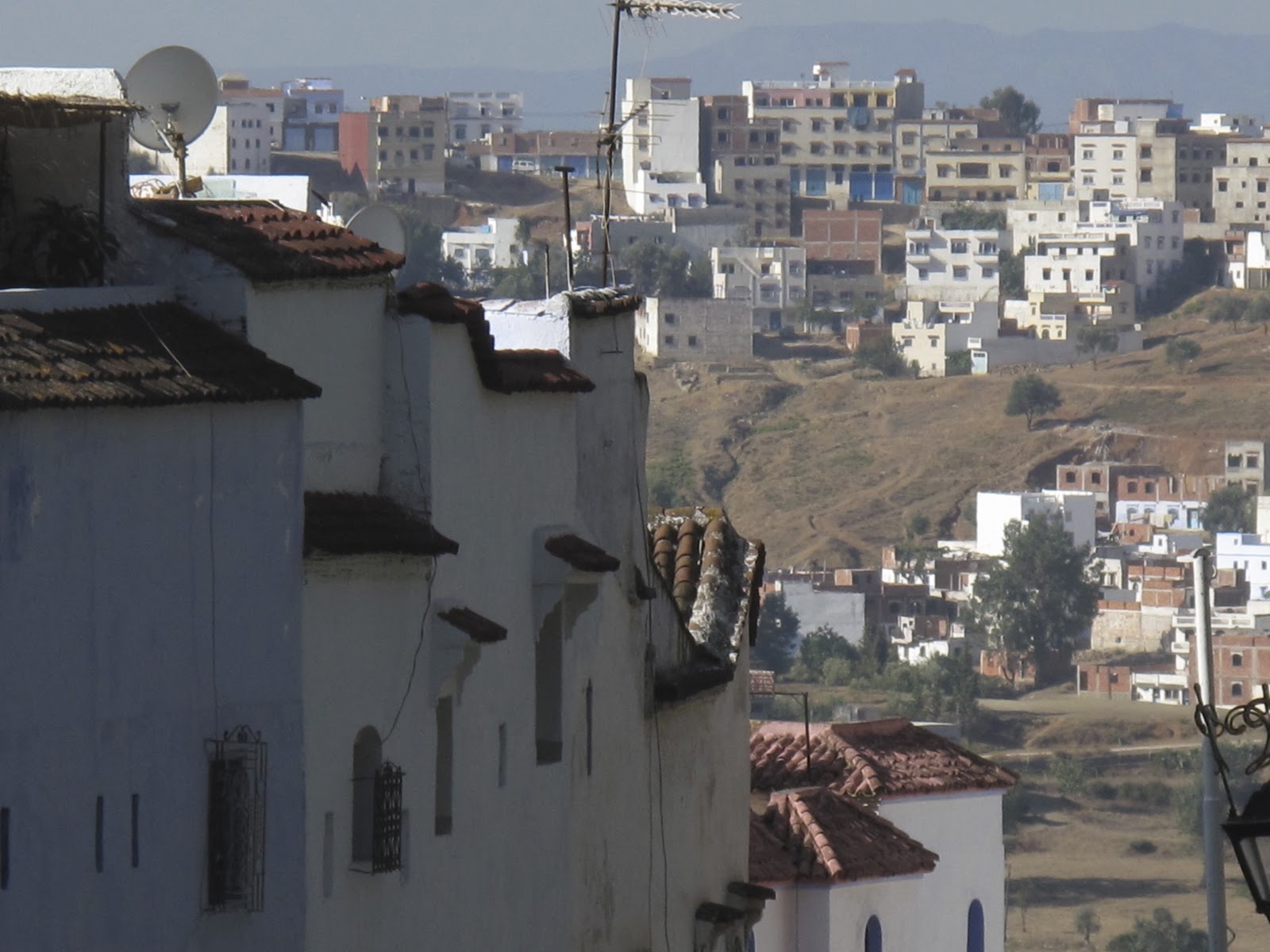
Tucked high in the rocky Rif Mountains, just inland from Tangier and Tetouan, is a city painted blue. Chefchaouen, or just Chaouen to the locals, can be spotted from a distance, easily identifiable against the stark rocks, with its blue toned buildings and red slate roofs. Entering the medina immediately leads to a twisting warren of blue alleys and passage ways.


I heard conflicting tales as to why the lower half of every building in the medina was painted blue. One story says that it was started by Jewish refugees during the 1930s, but my guide also mentioned how the blue comes from a local pigment in the rocks of the area, and that it is the shade of Islam. 


Whichever may be the case, the effect is stunning.  Vivid splashes of cobalt, turquoise, teal, white and cyan surround each corner and cobbled alley. Every surface of the bottom ten feet is painted, and although it is apparent that different coats and shades were used, everything is the same hue. I also saw several people touching up their blue walls with a fresh coat of the same paint. It almost felt like walking into an aquarium tank, there is so much of the color, that things not painted, like the street or people, seem to take on a faint indigo tint. 

The ancient walls still stand around the small village, and several minarets dot the skyline above the houses. There was something ancient and untouched about the quiet lanes, and locals dressed in traditional mountain garb. Men wearing full length, woven djellabas, and the women in brightly colored swatches with hats made from straw that are decorated with brightly colored yarn balls like mini-pompoms. 


And throughout the medina were the small, colorful shops of proud Berber craftsmen, selling leather goods, clothing, carpets and much more. At the furthest end of the village, a natural spring gushes forth from the mountain side. Gathered around are the rough mountain women, scrubbing their laundry and their children splashing through the shallows, on the hot Moroccan afternoon. I was sad when the day came to an end, and it was time to leave. I wanted to stay transported back in time, by this tiny untouched village.

Sunday, November 14, 2010

Into the Maze

Many cities in Morocco contain a medina. The medina is generally walled in, and is a warren of narrow and maze-like streets, lined with white-washed and tiled buildings. The first medina I visited was in Tetouan, near the northern coast. It was market day and many of the Rif mountain women had come into town to sell their produce. 


The Berbers from the Rif Mountains are the original inhabitants of this north Moroccan area. They call themselves Amazigh, which means The Free People. The Berber name for Tetouan means literally "the eyes."


The surprisingly quiet corridors were bordered by mounds of fresh fruits, caged chickens, mules pulling carts, fresh fish, nuts and spices. Further into the maze there are quarters for different craftsman, tailors or woodworkers store fronts clustered together. All throughout the medina were small children, just watching the adults go about their day.  At the center I found and incredible Tea House, an unimpressive exterior gave way to incredible carved walls, and a fountain amongst the colorful table clothes. 


In the Berber complex there was a carpet sales room. And once the seller had you cornered it was a deluge of unrolling carpets. Though he was disappointed that I would not buy anything, the carpets were like works of art and he shared a lot of interesting information about how they were made. For instance, all of the dyes are made from local elements, mint or absinthe to make green, saffron petals for blue, paprika for yellow, turmeric for orange, and sumac for  black.


Thursday, November 4, 2010

La Alhambra

Balanced atop the foothills of the Sierra Nevadas is the Alhambra. From a distance it almost looks like the fortress is an extension of the rock it was built into. The stones of the fortress blend so well to the rocky outcropping that the term Alhambra literally means "the red one" in Arabic.


But it is on closer inspection that the works of incredible beauty, from graceful calligraphy to elegant arabesque, which adorn the walls, columns and ceilings of Alhambra, become apparent.


The art and architecture is the culmination of centuries of tradition and innovation in the art of Islamic influence in Spain. 

As the rooms of the sprawling palace unfold, you are able to see the different layers, which were added at different eras. The Alhambra began with the original 9th century fortress, built for basic military needs. But during the mid 14th century the Moorish rulers converted the citadel into vast palatial suites, when much of the intricate architecture and delicate decoration were added.

 Later, after  the Reconquista by the Reyes Católicos, it became a palace for the Christian rulers as well. 


Adjacent to the palace of the Alhambra, is the Generalife, this is the summer palace of the Moorish kings.  The name is derived from Arabic, Jannat al-Arif, meaning Garden of the Architect. At its center is the  Water Garden Courtyard, consisting of a long pool framed by flowerbeds, fountains, colonnades and pavilions.


Wednesday, October 27, 2010

Las avenidas de Andalusia

At the southern end of the Iberian Peninsula the inhabitants of Andalusia have cultivated a rich cultural identity. As a historic gateway between Europe and Africa there are so many unique details and stunning architecture. It was difficult to wander the streets of Andalusia and not shoot everything, but here are a few shots that remind me of the hot summer afternoons in Espana.


Hammam Arabic baths throughout Andalusia fill underground cisterns with cool water, beneath the sizzling summer heat, and reflect the remaining Moorish influence in Southern Spain.


Peeking in past the hot stone walls of the street revealed cool lush patios.
The walled courtyards of Granada are beautiful carmens, gardens with shadowed trellises and ponds.


Late afternoon sun illuminates boys skateboarding on the outskirts of Granada.


As always, I couldn't resist a self portrait, this time in a door handle.


City on Seven Hills

Before I get ahead of myself and delve into Spain, I wanted to share a few more street shots from Istanbul. 

The skyline of Istanbul is marked by the pointed minarets of mosques. There are somewhere are 3000 mosques in the city. The Sultanahmet (Blue Mosque) at the center of the old city, the Suleymaniye with its Ottoman architecture, Yeni Cami (New Mosque) beside the Spice Bazaar surrounded by flocks of birds, too name a few. Even the Hagia Sophia, which was once a basilica then a mosque and now a historic museum, combining the elements of both backgrounds. Throughout the day I could here the call to prayer from various mosques in whatever neighborhood I happened to be exploring, the voices of the muezzins blending, yet each voice distinct. 


The Topkapı Sarayı (Palace) was the seat of power for the Ottoman Sultans for duration of their reign, over 400 years.  The Topkapi is located on the Seraglio Point, overlooking the Golden Horn and the Sea of Marmara, as well as the Bosphorus. The architecture is a dazzling array of arches and gates, patterns and gilt separated by gardens with geometrical designs and mirrored pools. The palace is a complex made up of four main courtyards interwoven with smaller buildings and enclosures. Nearly 400 of the rooms were devoted to the Imperial Harem, with a complex with intricacies of its own. 


Tuesday, October 26, 2010

Tinto de Verano


The city of Granada is nestled at the foot of the Sierra Nevada mountains. The city is believed to have taken its name from the Spanish word "Granada" meaning "pomegranate". But I also heard the the meaning of Granada referrred to as "hill of strangers"


Granada  is a mixture of cultures, where West meets East. Occupied by the Muslims, there are beautiful examples of Moorish architecture tucked away on every block, from El Bañuelo to the Alhambra. Later reconquered by the Reyes Catolica the inahibitants of the city were forced to convert to Christianity, but the ornate architecture was left in tact. The ancient Moorish quarter of the city, the Albaycin, is still filled with white wash walls, hidden arab baths and stunning views of the rest of the city.


The tapas culture reflects the Spanish approach to life. A very relaxed meal, while socializing and tasting lots of delicious morsels. There is no sense of urgency, meals may take hours. Just like the locals who are expected to be at least 15 minutes behind schedule. A "tapa" is a "lid" or "cover." In the early days of tapas a slice of cheese or ham on bread was given with your drink and placed over the drink, to cover the wine while you were not drinking. There is an old law on the books in Granada that states that a tapa must be served with every alcoholic beverage. The story goes that the King wanted to to "cover" the drunkenness by having drinkers eat a bite with every beverage, thus not getting as drunk as on an empty stomach. I loved that even late at night you would find drinkers sitting under the street lights sipping a Tinto de Verano ("summer wine") and nibbling tapas as they converse.